Tuesday, November 10, 2015

Textual Analysis: Final Paper (#2)

Funny Business
(Paper #2)
            Another day, another mind numbing topic that really grinds my gears. I’ll be honest, when I was told I had to do a thorough analysis on a few advertisements of my choice, I was dreading it wholeheartedly. Therefore I had to ponder for a while with the almost frustrating question of “What on god’s green earth is my topic going to cover?” To that question I searched endlessly through Google images for advertisements until I struck gold with something funny enough to catch my interest. There were a few insurance ads I saw from companies like Progressive with their quirky spokesperson Flo, and how I laughed whenever I thought of the commercials with her sponsoring the product. Usually the topic of insurance would bore an individual like myself, but while these ads encompassed easier, and cheaper ways to save on money, they also did it through comical methods that had me smiling. So I decided to find another ad that revolved around this method, and this time asked myself “how does comical advertising persuade the audience to buy their product/service?”

            To my surprise when I compared two humorous ads involving insurance, I found a few unique similarities. Right away I saw in several Progressive and Geico ads they had used the color blue to express their company logo, but why does this matter? Usually insurance companies want customers/the audience to know they’re serious about their work, and will help you when you call them which is why they choose the color blue to label their logo because it typically means loyalty, and professionalism. Another fun fact is that blue makes you feel more awake because it fills you with endorphins. Windows used blue originally to do this, so does Google and many other businesses. If they were to use another color like green it would instead be associated with greed or jealousy, and wouldn’t get the same point across, sending the audience away instead.

https://lh6.googleusercontent.com/431Dk2QCDK0nheWP9IOEJ2-KJN5xJ0vJb8NaXwyxfhe59nUrhyfZRR2tACNFSp5CG5vEH0gymVaHaAcbklugSCaPS7SGd-aVkeOInFSEq-zPubN8mBelhF7lC6gzc8BkdmrcI0AH            Moving forward to the image in the Geico ad… If you saw some crazed professional Laker’s basketball player (who looks somewhat like a caveman, keep this in mind) with his mouth agape in wild surprise, it would probably fill you with a case of the giggles too. I believe they used a basketball player opposed to say, a lawyer because it would come out as sort of odd. Anything but a basketball player/athlete would be less brutish and less caveman-ish. It’s more humorous. With an athlete a person would expect strange faces while shouting cheers of joy, but with a lawyer (or professional business man) instead it might come across as an angry expression. Their idea was to draw a lot of attention to the man’s appearance, so the viewer would shift there gaze to the text describing what their company is trying to offer. In this case there is text saying that it’s “so easy even a caveman can do it.” This is a funny way of saying that there insurance procedure is so easy that even a man (or woman) millions of years ago without the slightest idea of how to use technology could “(easily) save hundreds on car insurance.” Of course once they called, or went to the company’s site to get a “free quote,” that is. The purpose of this ad is to enlighten the heavy subject of insurance with laughter, and thus in catching the audience’s attention and diverting it to the text they may understand that there is an easier way of going about saving money.


https://lh4.googleusercontent.com/8vef3SbD-Hbl7GLPY7MHLr65GYNpSwctmhNTs2BF91xisoI7YpDGndq6Mnx-oChcepFONIMDgXCouo6vHAvVFvHPNQz5jquK7-FRQ4wtKtGcrTGIxVXDfFH_h30O8WoPzz0P3XnB            Let’s look back first to when I was mentioning Progressive’s ad involving there spokesperson Flo. Aside from the contagious red-lipped smile on her face the viewer would probably wonder why this particular printed ad would attract them. The idea is that you’ve already seen the TV advertisements involving her spreading the word of Progressive’s insurance rates in bizarre ways. And I mean really bizarre such as smashing an electric guitar, or spinning a basketball.  As well as setting a metaphor that states that they (Progressive) save the individual more money than other businesses by having two men from those corporation spy on Flo, and several other scenes that try to grab the viewer's’ attention (like the Geico ad). It’s with Flo’s enthusiastic expressions about the greatness of Progressive in these scenes that grabs a person’s attention. Hypothetically though, let’s say that the person watching these commercials were too distracted by the plot of events that they didn’t get the full idea of how it was trying to persuade you. In this case the printed ad I stumbled upon would inform a person who is familiar with the character Flo to shift their gaze to the ad, and inform themselves with the text hovering to the side of her. They would see that “you could save $550 on your car insurance,” and would result exciting the viewer who needs better coverage. Better yet, it would thrill them once they learned that it would only take about “6 minutes” to start. Thus convincing the audience that there policy is a quick, easy process that will leave you as content as the lovely Flo.

            In conclusion these ads use comedy for what they're trying to convey to the audience. By using odd expressions, contagious smiles, and memorable scenes as reminders I was able to infer that such aspects provide a more positive exposure of the product of insurance. So while at first I found this paper to be rather aggravating, I’ll admit that it highlighted certain aspects I didn’t put into deep thought before as to why a color could show-off a type of theme, how a basketball player over a lawyer in an ad could shape a persons perspective, or how a whimsical character could make an ad become frequently more familiar.

In Class Lab: What's really being said and how?

~What arguments does the author make?
  • The argument that white people and people of color who are not black should not use the n-word
  • The argument that there are two separate conversations by black people and white people and as white people, we should not have anything to do with the conversation that black people are having about the n-word.
  • The author argues for a clear position against the usage of the n-word by any group of people who are not black.
  • The argument is not ambiguous or long enough to call for an in depth analysis. The author is extremely straightforward in his reasoning but he does use personal anecdotes as justification and evidence for his argument.
  • The author makes the argument that even beyond use of the n-word, terms such as “redneck” or any possibly racist slur shouldn’t be used by people outside of the “family.”

~How persuasive do you find the argument?
  • I think the argument is quite persuasive because it is very open, and only really displays facts and the author's opinion. The author is trying to persuade you that he is right, and he backs up his own personal opinions with facts and ideals that are current to the argument of racism.
  • The speech is void of any exact sources or links because of it being an oral presentation. Though the speaker himself is quite credible due to his extensive background in anti-racist writings and speeches since 1995. He also has been updating teachers about how to teach kids un-racist and anti-racist topics.
  • The argument is persuasive because he backs up his opinion well through facts and widely accepted ideas that cannot really be challenged without the challenger being considered “racist”.

~What is the author’s stance?
  • The author objectively describes how the use of the n-word should be only be used by colored people in contrast to a white person because otherwise it would be considered racist.

~Does the publisher bring a certain stance to the work?
  • In this case, there was not a publisher attached to the work. However, the argument was originally published in a book by the author, “White Like Me”. When just discussing the video, we have no publisher to consider. If we turn our focus to the book, we may find a stance that was brought by the publisher.
  • If you consider YouTube the publisher, the author had the ability to turn off comments (which he did), and that itself brought a support to racism and their claim, because since it is the internet it is guaranteed someone would have started a debate and been racist in the comments.


~Do you recognize ideas you’ve run across in other sources?
  • Technically not a source, but in my everyday life I have found this controversy a lot, from music the word is used in, to improper use. For me personally (Chloe), I have always had an issue with the idea of “I’m from ___ race, I can make fun of them!” and I think that this source helped better define this idea in a non-racist way.

~Does this source support or challenge your own position -- or does it do both? EVERYONE SHOULD ANSWER
  • Chloe: This source supports my position and makes me believe even more strongly in how people should not use racial slurs such as the n-word. However, the idea that people can depreciate their own people groups is an interesting way to state that, because before this source I didn’t agree with it (as mentioned in the last question).
  • Jacob: This source definitely supports my position. Right before viewing the video I knew the n-word was inappropriate to use in my vocabulary, and by watching the video it furthered my knowledge on why it’s wrong. It showed a unique perspective on how the word should only be used in its own color group, but even then it still seems like it dehumanizes the value of a given people.
  • Riley: This source supports my position. I agree with the arguments being made by Tim Wise in that the use of the n-word by white people like myself and other non-black people of color is inherently racist because of the historical context behind it. As a people, whites have used the word to continually dehumanize black people, whether it is through slavery, micro/macro aggressions, or even large scale institutionalized racism.
  • Corben: This speech supports my own personal opinions on racism. I believe that white people don’t have the “rights” to the n-word and trying to make it okay to use in “politically correct” context is not something good to do. Just leaving the n-word to colored people to use how how they see fit is the best option, we as white people used and abused the word and now we should have no say in the matter.
~What can you tell about how the intended audience and purpose?

  • As a white person this spoke to me on high levels. The purpose of the video was to inform the audience that the use of the n-word is not funny business, or cute, but in fact a still modern racially charged term that shouldn’t be used by white people.

"THINK ABOUT YOUR WRITING" Exercise (p. 70)

Recently I was asked to write about which contributes more to a person's life style with nature or nurture. My idea was that it can't just be one or the other, but both because they shape us hand-in-hand. From birth we are nurtured into learning how to speak, how to walk, what to eat, and determine the meaning between right and wrong from our families, Then with our environment (nature) we learn street smarts, look up to friends, get taught by our teachers, and adapt to the surroundings. Without the both of them we couldn't create our own unique identities in the world, and we'd all be isolated from eachother.

Sunday, November 8, 2015

"Yes, We Can." Response (p. 69)

Watching the video with the addition of music, voice-overs,written works (like "hope" and yes, we can"), and images of the singers and Obama delivering the speech I noticed a few powerful things that contributed to the argument. One of which was repeated, and stated that we are all equal whether you're black or white (thus why there wasn't any color being betrayed while watching). It was also treating people who could only talk through sign language as equals when they provided an image of a women using sign language, and included other people speaking different languages in the video, Mostly though it was the fact that it is in video form because  when I read it, it was already excellent, but when it became verbally spoken it became something absolutely extraordinary.

Thursday, November 5, 2015

In Class Lab: Memes (Group Activity)

(#1)
http://www.grumpycats.com/like-a-good-neighbor/

Questions:
  1. How does it appeal to you-or why does it fail to appeal?
It appeals and it’s funny to me because it’s a jingle, but it’s not because it’s how a lot of people think of their neighbors, and because it’s relatable and a play on words it adds humor.

     2.) What kinds of words, images, or sounds does it use as support for its position?
This is a set of words that is a jingle or small musical line, though it doesn’t have any sound to it, most people know that it is sung to the sound of the State Farm jingle.

     3.) If you were going to revise it for a different audience, what would you do?
I would  change the style of fence to suit a more modern audience.  I would change the color of the font to something more interesting for a more whimsical or young audience.

     4.)  If you were going to create it in another medium, how would it be different?
If we were to, say, make it a state farm TV commercial, it would be much different because then it wouldn’t be as realistic, since the cat would probably have a voice actor or it would be silent and awkward. It works (really?) purrfectly (I mean rEALLy?) just to be one picture.


(#2)
https://www.pinterest.com/pin/292522938267517733/
Questions:
  1. How does it appeal to you-or why does it fail to appeal?
It appeals because many people defy law and talk on their phones while driving and it results in distraction that can rightfully cause the expression on the feline’s face.


     2.) What kinds of words, images, or sounds does it use as support for its position?
Just a picture is the perfect medium for this joke/comment because it’s the cat’s grumpy expression of disapproval and a fact most people would relate to by saying something stupid like “true.” or “same.”

     3.) If you were going to revise it for a different audience, what would you do?
Well, the joke really isn’t the same if you target the non-driving audience. So if I were going to aim it at non-meme-loving adults I would probably make it a serious commercial that everyone turns off.
     4.)  If you were going to create it in another medium, how would it be different?
If it was going to be in another medium it would be much different, because the cat would become a symbol for a people group or something overly complicated.

(#3)
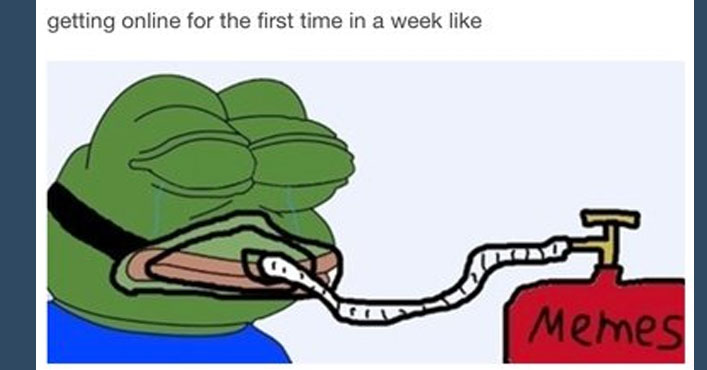
http://cdn.smosh.com/sites/default/files/2015/03/pepe-gas.jpg
Questions:
  1. How does it appeal to you-or why does it fail to appeal?
It fails to appeal because of the overall tackiness of the image.
But it’s message is funny because it’s true.

     2.) What kinds of words, images, or sounds does it use as support for its position?
It has a line of text to caption the photo, describing what the photo is emotionally meant to be. It is not a description of any sort of scene, it is describing the emotion portrayed by this rare pepe meme.

     3.) If you were going to revise it for a different audience, what would you do?
I would use a more sophisticated image and give it a color background.

     4.)  If you were going to create it in another medium, how would it be different?
I would write it up as a joke.  So there would be more words and no image  or make it a comic type of meme with more panels.
(#4)     :D  https://instagram.com/p/5nY_eZCFoT/


Questions:
  1. How does it appeal to you-or why does it fail to appeal?
It appeals to me because despite feeling sad Pepe (the frog) was able to feel a sense of happiness in hearing his favorite jam.


     2.) What kinds of words, images, or sounds does it use as support for its position?
Pepe (the frog) has a top hat, and cane with a frowned expression while dancing which indicates that despite his sadness, he still has rhythm to his own favorite music choice.

     3.) If you were going to revise it for a different audience, what would you do?
See 4. Maybe for little kids it would be more funny, less sad, and a longer video.

     4.)  If you were going to create it in another medium, how would it be different?
I might make it a gif image, so that the pepe is dancing and tears are streaming down his face, it really portrays more emotion in motion rather than the still image.


Bibliography(s):

#1: Cat, Grumpy. “Like A Good Neighbor.”Cartoon. Grumpy Cats. 20 Feb. 2013. Web.11 November 2015.

#2: Marie, Candice.”Grumpy Cat Meme.“ Cartoon. Pinterest. 5 Nov. 2015. Web. 11 November 2015.

#3: sadfrogmemer. “Getting Online for the First Time in a Week Like” Cartoon. Smosh. 2014 Web. Nov 5, 2015.

#4: tcenews. “Sad Pepe Meme” Cartoon. Instagram. 26 July 2015. Web. 11 November 2015.

In Class Reading: (Exercise p. 62)

Positions I have taken:

  • Running helps me concentrate.
  • There is a right balance for fruits, veggies, and meats.
  • I believe having a project, an exam, modules, and house work should be all due on the same day because it is too much stress.
  • A person's health should come before work, so that the work can go without error.
  • To keep going even when it's hard, so that it doesn't continue to get harder later on.
  • College is more informal then High School.

Some else taking a position:

  • My parents decide to cook at least one new recipe every week, so that we could expand our options of food.
  • A friend decide an apple was better for them then chips.
  • A person proclaimed ignorance, and overconfidence are those who put work to be done later, then the free time they have now.
  • An acquaintance believes a persons words backed up with research has a better argument. 

Tuesday, November 3, 2015

Textual Analysis: Advertisement Outline (Paper #2)


INSURANCE Advertisements:
1.) Who published these ads?
Progressive, an insurance company.
2.) Who are these texts intended for? (Or) Who would each one seem to appeal to?
This ad is aiming at people who own a vehicle to be the boss of there auto insurance. Mostly men given the attractiveness of the woman.
3.) How can we tell that (or reasonably guess)?
The woman (Floo), is  is holding a box labeled "auto insurance".
4.) What is the purpose of these texts? What are their creators wanting to change or make happen?
There purpose is to provide an easy method for people owning vehicles to save better on there car insurance. For only being about 6 minutes this captures the attention of individuals who want to quickly save on there car insurance.
5.) How do they seem to be working toward that purpose(s)? What beliefs and values do they address?
It addresses the fact that Progressive Insurance can save money by getting rates, and coverage options.
6.) What evidence from the texts can you provide to support your answers?
The quirky woman in the ad greets the viewer with a smile as she holds a box labeled auto insurance with the text indicating that you could "save" on your car insurance! It implies that it would take about 6 minutes to get great rates, and coverage options when you save with Progressive.

Describing the Ad: A signature green eyed, red lip stick, "I (heart) Progressive" button, blue band, and you have Progressive iconic girl named Flo. This woman represents Progressive by sharing that there Auto insurance can save you money when you get "rates and coverage options" in about 6 minutes when you call, or explore there site. In the background it indicates there willingness to save people money "24/7".


Describing the Ad: Geico insurance with it's nameless smiling British talking gecko mascot  gives detail on how "you could save 15% or more" on spending with vehicles, home's, renters. motorcycles, and/or boats. It talks about how it offers convenient local offices, coverage availability by phone, money-saving discounts, low down payments, monthly payment plans, 24-hour service/claims, and available SR 22s.


Describing the Ad: Allstate insurance indicates that "you're in good hands" when you're under there policy. They provide a picture of a family supposedly being under the insurance companies personalized protection, and smiling because they got a quote from there "exceptional customer service" agents. It also provides symbols of a house and car insured will save money.